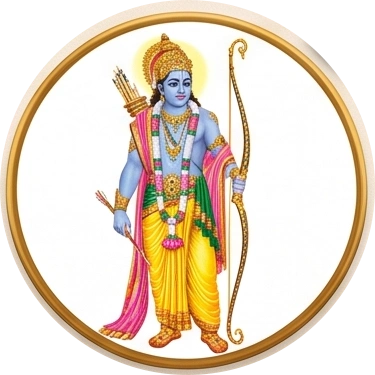
भगवान राम

षोडश गुण: वाल्मीकि रामायण में आदर्श पुरुष के १६ गुण

नारद द्वारा वर्णित वे गुण जिनसे वाल्मीकि ने रामकाव्य रचा

परिचय

वाल्मीकि रामायण की शुरुआत में नारद १६ गुणों वाले पुरुष का वर्णन करते हैं—और वह पुरुष राम हैं।

Unlike abstract theological concepts, the 16 attributes form an exhaustive framework for complete human character—spanning moral, psychological, physical, tactical, and spiritual excellence.

समेकित चरित्र-चक्र

श्री राम के षोडश गुण

हर पंखुड़ी एक गुण है; किसी गुण को चुनकर नीचे उसका शास्त्रीय संदर्भ और उदाहरण पढ़ें। चक्र इन गुणों को परस्पर पूरक दिखाता है, श्रेणीक्रम नहीं।

Endowed with noble and harmonious personal characteristics

मंत्र

सूची

Gunavan refers to a person whose baseline character is constructed from intrinsic virtues such as kindness, patience, rectitude, and integrity, rather than external pretension.

Valmiki Ramayana, Bala Kanda (1.1.2): 'Ko nvasmin sampratam loke gunavan kashcha veeryavan...'

Rama treated everyone in Ayodhya—from royal ministers to street sweepers—with identical politeness and genuine concern for their personal well-being.

Veeryavan signifies both physical heroism and moral courage to confront formidable evil without flinching.

Valmiki Ramayana, Bala Kanda (1.1.2)

As a young prince, Rama accompanied Sage Vishvamitra into the dense forest and single-handedly neutralised the formidable demoness Tataka and repelled Subahu's forces.

Dharmajnah is one who understands the subtle nuances of duty across varying situations and contexts, ensuring justice is served accurately.

Valmiki Ramayana, Bala Kanda (1.1.2): 'Dharmajnascha krutajnascha...'

When deciding the fate of Lanka after Ravana's defeat, Rama immediately appointed Vibhishana as king, demonstrating that he fought to uphold Dharma, not for territorial expansion.

Krutajnah is one who never forgets a kindness or service rendered by others, regardless of how minor the deed may seem.

Valmiki Ramayana, Bala Kanda (1.1.2)

Rama expressed lifelong gratitude to Jatayu, performing his final rites with the full honors of a father for sacrificing his life to protect Sita.

Satyavakya implies that every word uttered is truthful, binding, and fulfilled without compromise.

Valmiki Ramayana, Bala Kanda (1.1.3): 'Satyavakyo drudhavratah...'

Rama willingly abandoned the throne of Ayodhya on the day of his scheduled coronation to uphold his father King Dasharatha's word to Kaikeyi.

Drudhavratah is one whose resolve does not break under hardship, temptation, fear, or external pressure.

Valmiki Ramayana, Bala Kanda (1.1.3)

When the sages of the Dandakaranya forest asked Rama for protection against demons, he gave a solemn vow that he adhered to throughout his 14 years of exile.

Refers to exemplary habits, spotless personal reputation, and moral discipline maintained continuously in private and public life.

Valmiki Ramayana, Bala Kanda (1.1.3): 'Charitrena cha ko yuktah...'

Throughout his wandering in the wilderness, Rama strictly adhered to the vows of an ascetic-kshatriya, maintaining purity of mind and conduct at all times.

Sarvabhuteshu Hitah represents universal empathy that extends beyond human society to animals, nature, and even foes.

Valmiki Ramayana, Bala Kanda (1.1.3): 'Sarvabhuteshu ko hitah...'

When greeting the people of Ayodhya or forest ascetics, Rama inquired first about their crops, livestock, health, and domestic wellbeing.

Vidvan denotes deep intellectual comprehension combined with practical discernment and real-world application.

Valmiki Ramayana, Bala Kanda (1.1.4): 'Vidvan kah kah samarthascha...'

Rama mastered the Vedas, Vedangas, military tactics, statecraft (Niti Shastra), and fine arts under the guidance of Sages Vasistha and Vishvamitra.

Samarthah is the practical capability to translate intent into successful execution under severe constraints.

Valmiki Ramayana, Bala Kanda (1.1.4)

Rama strung and broke the formidable Pinaka (Lord Shiva's bow) at King Janaka's court, a task that countless powerful monarchs had failed to even lift.

A person whose very presence, demeanor, and facial expression radiate serenity, reassuring everyone who looks upon them.

Valmiki Ramayana, Bala Kanda (1.1.4): 'Kashchaika priyadarshanah...'

Even during moments of immense sorrow or crisis, Rama's countenance remained placid, calm, and comforting to his companions.

Atmavān describes one who is not swayed by dualities like joy and sorrow, gain and loss, or praise and blame.

Valmiki Ramayana, Bala Kanda (1.1.5): 'Atmavān ko jitakrodho...'

Rama received the news of his coronation and the news of his immediate exile with the exact same serene expression.

Jitakrodhah is one who never allows anger to cloud judgment, using righteous force only as a last resort for justice.

Valmiki Ramayana, Bala Kanda (1.1.5)

Rama forgave Jayanta (Indra's son) who had harmed Sita in the forest, sparing his life and granting him a minor penalty instead of destruction.

Dyutiman refers to an intrinsic intellectual and spiritual luster that commands natural respect without intimidation.

Valmiki Ramayana, Bala Kanda (1.1.5): 'Dyutiman ko anasuyakah...'

When Hanuman first met Rama and Lakshmana in Kishkindha disguised as a mendicant, he immediately recognized their royal aura despite their humble ascetic robes.

Anasuyakah is one who genuinely rejoices in the success, praise, and prosperity of others without a trace of competitive bitterness.

Valmiki Ramayana, Bala Kanda (1.1.5)

Rama never felt jealousy toward his brother Bharata when the latter was given the kingdom, instead praising Bharata's fitness to rule.

This 16th quality highlights that when Rama's righteous indignation is finally ignited on the battlefield to protect Dharma, no force in the cosmos can withstand him.

Valmiki Ramayana, Bala Kanda (1.1.6): 'Kasyabhyasuyate devashcha jataroṣasya samyuge...'

During the war in Lanka, when Rama unleashed the Aditya Hrudayam-empowered Brahmastra arrow, it broke Ravana's invincible defense and ended the cosmic threat.

निष्कर्ष

षोडश गुण आदर्श चरित्र की रूपरेखा हैं—शक्ति के साथ संयम।

ये गुण आज के नेतृत्व और पारिवारिक धर्म के लिए भी मार्गदर्शक हैं।

← सभी देव-देवी