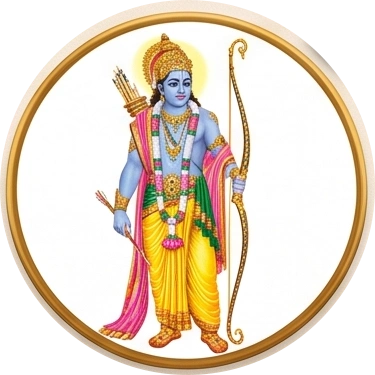
भगवान राम

मर्यादा पुरुषोत्तम: राम के आठ आदर्श गुण

विष्णु के सप्तम अवतार क्यों नैतिक सीमाओं और कर्तव्य के आदर्श हैं

परिचय

अन्य अवतारों के विपरीत राम ने मनुष्य रूप में धर्म का व्यावहारिक आदर्श दिखाया—शोक, युद्ध और त्याग में भी मर्यादा बनाए रखकर।

मर्यादा = Boundaries, limits, cosmic rules, or codes of ethical conduct. | पुरुषोत्तम = Purusha (Man/Entity) + Uttama (Supreme/Highest). | अर्थात् धर्म की सीमा में रहने वाले सर्वोत्तम पुरुष।

समेकित चरित्र-चक्र

मर्यादा पुरुषोत्तम के आठ गुण

हर पंखुड़ी एक गुण है; किसी गुण को चुनकर नीचे उसका शास्त्रीय संदर्भ और उदाहरण पढ़ें। चक्र इन गुणों को परस्पर पूरक दिखाता है, श्रेणीक्रम नहीं।

धर्म (नैतिक कर्तव्य)

मंत्र

सूची

Rama does not merely follow Dharma; he embodies it. As Sage Maricha states in the Valmiki Ramayana, 'Ramo Vigrahavan Dharmah'—Rama is Dharma personified. His choices are consistently guided by systemic ethics rather than personal convenience or desire.

Valmiki Ramayana, Aranya Kanda (Chapter 37, Verse 13): 'Ramo vigrahavan dharmah sadhu satya parakramah' (Rama is the embodiment of righteousness, noble, and truthful in prowess).

When offered the throne of Ayodhya by his brother Bharata in the Chitrakoot forest, Rama refused to return. Though the ministers, citizens, and elders begged him to break his exiled state, Rama maintained that breaking a royal decree or an oath to uphold his father's honor would destroy the foundation of public law.

For Rama, truth was not an abstract concept but a concrete vow. A single broken word destabilizes the trust upon which society rests. He lived by the principle of 'Satyavrata'—one who has taken an unshakeable vow of truth.

Valmiki Ramayana, Ayodhya Kanda (Chapter 109, Verse 13): 'Satyam eva iswaro loke satye dharmah sritah sada' (Truth is the supreme power in the world; righteousness always rests on truth).

On the eve of his coronation as Crown Prince of Ayodhya, when Kaikeyi demanded his 14-year exile to the Dandakaranya forest to fulfill Dasharatha's old boons, Rama accepted without anger or hesitation. He treated his father's spoken promise as an absolute imperative.

Rama's compassion extended beyond caste, lineage, social standing, and species boundaries. His empathy was not a weakness but an active, magnanimous force that granted safety to anyone who sought refuge (Sharanagathi).

Valmiki Ramayana, Yuddha Kanda (Chapter 18, Verse 33): 'Sakrideva prapannaya tavasmiti cha yachate, abhayam sarvabhutebhyo dadamyetad vratam mama' (To anyone who seeks refuge in me even once, saying 'I am yours', I grant fearlessness to all beings. This is my solemn vow).

When Vibhishana, the brother of his arch-enemy Ravana, fled Lanka and surrendered to Rama, the vanara generals advised executing him as a spy. Rama rejected their suspicion, stating that even if Ravana himself came seeking refuge, he would be protected.

True fortitude is maintaining mental stability when transitioning instantly from supreme comfort to absolute adversity. Rama exhibited zero psychological turmoil whether facing royal coronation or banishment into wild wilderness.

Valmiki Ramayana, Ayodhya Kanda (Chapter 19, Verse 37): 'Na vanavasa grahanat piturvachana karanat, karoti raghava krodham' (Rama felt no anger or distress upon accepting forest exile to fulfill his father's order).

Upon hearing of his banishment, his brother Lakshmana was consumed by fury and wanted to rebel against the court. Rama remained completely calm, calmed Lakshmana's rage, and re-oriented the situation away from civil conflict toward dutiful obedience.

Rama possessed formidable military capabilities (as an Atiratha warrior), yet his anger was strictly disciplined and reserved only for defending Dharma. He never operated out of personal vengeance, arrogance, or impulse.

Valmiki Ramayana, Bala Kanda (Chapter 1, Verse 4): 'Jitakrodho dyutiman anasuyako' (He who has conquered anger, is brilliant, and free from envy).

Even during the climactic war in Lanka, when Ravana was disarmed and helpless on the battlefield, Rama did not strike him down. Instead, he graciously said, 'You are tired and disarmed today. Return to your palace, rest, and come back tomorrow with weapons.' This reflected ultimate mastery over bloodlust.

Despite his divine origin and peerless skill as a warrior, Rama never displayed vanity. His interactions with people were marked by complete honesty, humility, and absence of deceit.

Valmiki Ramayana, Ayodhya Kanda (Chapter 2, Verse 33): 'Smita purvabhi bhashi cha' (He speaks with a gentle smile first, greeting everyone with warmth).

In his interactions with Shabari, an elderly ascetic living in the forest, Rama ate the wild berries she offered with deep gratitude, completely disregarding social hierarchies and focusing solely on the purity of her devotion.

Rama never took support for granted. He acknowledged every contribution to his cause—no matter how small—and shared honor and credit with his allies rather than claiming personal glory.

Valmiki Ramayana, Kishkindha Kanda (Chapter 4, Verses 12-15): Rama's initial dialogue with Sugriva highlighting mutual respect, friendship, and eternal commitment.

When building the Ram Setu bridge across the ocean to Lanka, Rama recognized the efforts of the little squirrels carrying grains of sand alongside the massive forest vanaras, teaching his army that sincere effort holds equal spiritual weight regardless of scale.

In an era where royal polygamy was standard political practice (as evidenced by his own father's household), Rama bound himself to a single wife, Sita, establishing an unprecedented benchmark for marital fidelity and equality in spiritual partnership.

Valmiki Ramayana, Sundara Kanda (Chapter 36, Verse 30): Sita describing Rama's undivided devotion, confirming that his mind and heart remain singularly dedicated to her.

When performing the Ashvamedha Yajna (imperial horse sacrifice) later in life—a ritual that scripturally required the physical presence of the Queen—Rama refused to remarry despite societal pressure. Instead, he had a golden statue of Sita placed beside him at the altar.

निष्कर्ष

राम दिखाते हैं कि आदर्श जीवन शक्ति से नहीं, मर्यादा से महान होता है।

आज भी सत्य, करुणा और कर्तव्य नेतृत्व का आधार हैं।

← सभी देव-देवी