Bihar, Jharkhand & Eastern Uttar Pradesh
Mahaparva Chhath
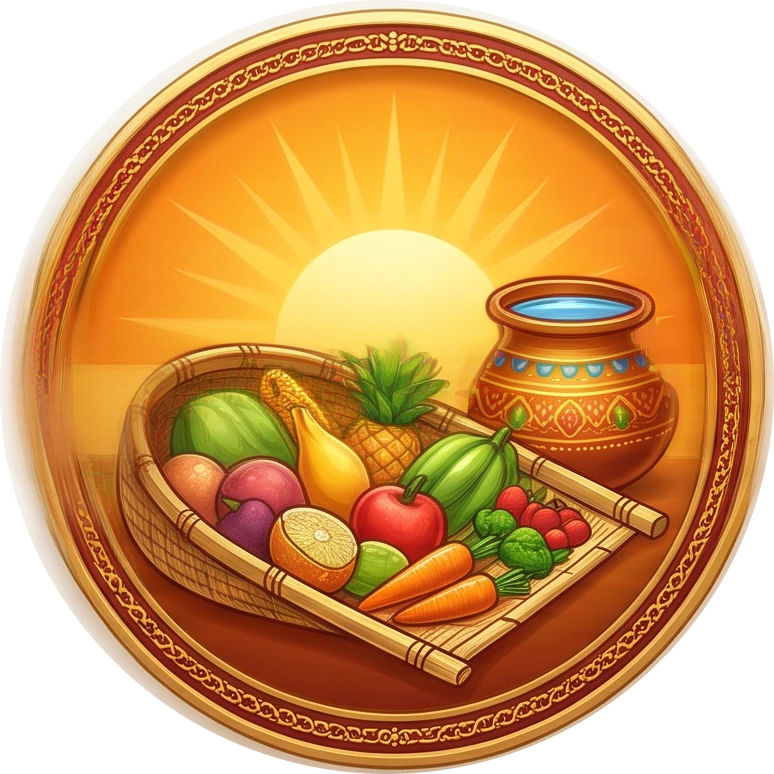
Entire communities migrate to riverbanks (Ghats) before dawn, carrying woven baskets atop their heads while women sing soul-stirring traditional Bhojpuri and Maithili folk songs.
Festival guide
The rigorous solar festival of purity, revering both the setting and rising sun with riverbank austerity.
Surya Shashti · Dala Chhath · Chhathi Maiya Puja
Chhath Puja is an ancient Vedic solar observance celebrated over four austere days without a mediating priest. Devotees honor Lord Surya and his consort Usha (Chhathi Maiya) through rigorous fasting, standing in waist-deep water to offer arghya to both the setting and rising sun for family well-being and health.
Deities: Lord Surya Bhagavan, Chhathi Maiya (Usha / Shashti Devi)
In the Mahabharata, Karna, the son of Surya, performed strict solar worship standing in river waters to distribute alms. It is also chronicled that Draupadi and the Pandavas observed Chhath vows upon the advice of Sage Dhaumya to overcome their adversity and regain their kingdom.
Egalitarian worship, deep personal austerity (Tapas), ecological purity, and expressing reverence for the cosmic sun as the visible sustainer of life.
The four-day cycle comprises Nahay Khay (sanctifying bath and meal), Kharna (evening kheer meal followed by a 36-hour waterless fast), Sandhya Arghya (offerings made to the setting sun standing in water), and Usha Arghya (offerings made to the rising sun, after which the fast is broken).
Mahaparva Chhath
Entire communities migrate to riverbanks (Ghats) before dawn, carrying woven baskets atop their heads while women sing soul-stirring traditional Bhojpuri and Maithili folk songs.
Chhath Parba
Ponds and riverfronts across Janakpur are illuminated with thousands of earthen lamps, where multi-ethnic communities participate equally without caste distinctions.
Chhath teaches honoring life in its entirety; revering the fading rays of the setting sun acknowledges maturity, rest, and completion, while the rising sun celebrates renewal and vitality.
Chhath is a direct communion between the individual devotee (Vrati) and the cosmic elements—water, earth, air, and the visible sun—retaining ancient egalitarian Vedic simplicity.